I can't imagine what it must be like to be kept away from your home, your family, your routines and all the things that help you feel safe for a whole year. And worse, to be held in a place where you feel unsafe and where nobody is interested in you as a person.
I am so proud of Steven's stoicism. To see him still trust people, leaves me in awe.
But there is definitely some trauma after the experience and I cannot forgive Hillingdon for not only causing it, but for repeatedly dismissing it since Steven came home. It is the main reason why I stopped attending meetings with Hillingdon's professional support team (positive behaviour support, the psychologist, the SALT, the OT) back in 2012. If they couldn't acknowledge the reality of Steven's trauma, then they couldn't be any use at all.
Steven is still terrified of being taken away again. He never understood why he was there, so even know, if he spills a drink, he cries and pleads: "not going back to M house?" Everyday, before he goes out, we have to reassure him that he's coming back home afterwards and not going to the Unit. If anyone mentions the name of the Unit, he yelps and starts to cry with anxiety. When we drive pass the place on the way to swimming, he turns away, closes his eyes and covers his ears. But that's not trauma!
He has never gone back to the respite unit either - it strikes the same level of terror. I don't blame him. It took a year after Steven came home for respite to be sorted because Hillingdon insisted the Unit was their only resource so had to be there. To illustrate the way their positive behaviour support works, they introduced "subliminal messaging" with him to get him to accept their plan for him to go back there for respite. It didn't work - Steven is far too fly for that.
I think those fears he has will be there for a long time to come. And they'll resurface when I'm no longer around to look out for him. But in the meantime, I believe Steven has the emotional fortitude to have a quality of life that is beyond the imagination of anyone involved in his care in 2010
Monday, 30 June 2014

Sunday, 29 June 2014
Story One Hundred & Three - Goodbye Whistler's Mother
The social worker (aka Whistler's Mother) finally left our lives in July 2011. We first met her in November 2007 when she was appointed Steven's transition manager. Its fair to say that it was four and a half years of carnage.
I remember the first meeting well. After meeting Steven just once, she was pushing for him to go to the positive behaviour unit. She talked about one of Steven's classmates who had recently been in the Unit and described it as "one of my big successes". Not " our" success, or "the units" success, but "my" success. I said to Julie after she left that we are dealing with a massive ego here. And I think its fair to say that her narcissism was the driver for many things that happened over the next four years.
In 2008 after Steven had been assaulted at the Unit by one of the staff, she tried to cover it up by leading us to believe it was one of the residents. From the time of the assault until the trial, she distanced herself and was no support whatsoever.
In May 2009 she visited me and told me that she would be taking Steven into care if Julie and I stayed together. It is true that Julie's mental health problems were causing lots of problems with Steven's care, but is it okay for a social worker to deliver that sort of ultimatum. I had to make the most dreadful choice and that is how Steven and I came to move to the flat in Uxbridge. I think the consequences of the social worker's ultimatum continued right up to Julie's death last month - she never got over losing her family.
And then of course, five months after Steven and I moved to Uxbridge, the social worker was the driving force behind the whole year that Steven was kept away from his home. Once again, I believe her ego played a big part in how the year unfurled. I could see that she couldn't stand me because I challenged her authority, which was very important to her. I didn't, and couldn't acknowledge her brilliance. The longer the year went on, the more entrenched and angry she became.
She managed to avoid both the initial December court hearing and the week long inquiry. I could see that Hillingdon didn't dare let her loose in the witness box but I also found it terribly weak that she couldn't face the consequences of her actions.
We now have a new social worker who couldn't be more different. She is down to earth and she is interested in Steven. She is prepared to fight his corner and I think she respects me. I said to her the other week that if we'd had her from the start, the events of 2010 would never have happened.
I bump into Whistler's Mother occasionally. We don't talk. I was in a pub with the H Man last year and we saw her sitting in an alcove with some colleagues. Next to her was a shelf with a large candelabra on. As we were leaving, the H Man said: "It was Colonel Neary, in the Slug & Lettuce, with the candlestick".
But I still find myself asking - " how can one person tear a family apart, leave a vulnerable young man traumatised, act unlawfully (as the court judged) and not have any consequences?"
Saturday, 28 June 2014
Story One Hundred & Two - Somerset
Two weeks after Justice Peter Jackson handed down his judgement, we finally got to Somerset, albeit a year late. I like the symmetry of that because, as you may remember, two weeks before we were due to go to Somerset in 2010, I had that horrible visit from the Unit manager who told me that he was cancelling the holiday.
On the second night there, Francis and Chris took Steven to see a Wurzels tribute band (yes really) and I sat outside the caravan on a sun lounger and wrote the final chapter of the book. Here it is:


On the second night there, Francis and Chris took Steven to see a Wurzels tribute band (yes really) and I sat outside the caravan on a sun lounger and wrote the final chapter of the book. Here it is:
Four Go For A Final
Chapter In Somerset
It’s 12th July 2011 and I’m writing this final
chapter, sitting outside a caravan in Brean Sands whilst Steven has gone to the
evening show with his support workers. Yes – we made it to Somerset. It might
be a year late but it feels great to have eventually arrived. There is
something poetic that Steven’s two support workers, F & C, who gave evidence
in court have come with us and it’s all very relaxed, and dare I say it, dead
normal. We packed a lot into the first day: we went to the pool and down the
water slide three times; we explored the theme park and last night we drove
into Burnham. That was a poignant journey, as it was the venue for our first
holiday with Steven in 1997. It was an odd feeling, because although this book
has been about an 18 month period that felt like 14 years; the 14 years since
our first holiday have flown by as quickly as 18 months. Steven and I marked
the occasion by recreating the Beautiful South video to “Perfect 10” on the
pier and I found the cafe where we used to have lunch every day in 1997. Sadly,
it was closed because of an “electrical fault” but that was okay because Steven
doesn’t do sentimental nostalgia.
The site we’re staying at in Brean is the same place we came
to in 2007 and everything looks the same four years on. I was recalling to the
support workers that there were many times in 2007 that I took Steven to the
pool or to the show on my own, without incident. One of the workers remarked
how much Steven has changed in that four years. He was of course, referring to
Steven’s behaviour. It wasn’t an unfair comment, considering there were three
of us supporting Steven on the holiday, all following the “risk management”
bible. When he said it though, both me and the other support worker immediately
said: “No – he hasn’t changed at all”.
That thought kept me awake last night. The only thing that
has changed is that Steven turned 18 and moved under the watchful, fearful eye
of the Hillingdon adult social care team. And because of the unfortunate
incident at the airport in 2008, he will remain stigmatised for the rest of his
life. It’s chilling that, in asking for some help four years ago, we have
changed our perception of our reality and doubt things that don’t need
doubting.
And in the middle of my reality is Steven. He has matured
greatly in the last four years. But he is still the same funny, anxious, inquisitive,
chatty, frightened, adventurous, playful, intelligent, street-wise autistic
young man who sat next to me on the log flume in 2007 (Holiday song: “Umbrella”
by Rhianna). He has the most formidable spirit and strength that kept him going
last year when it must have felt like everyone, including me, had given up on
him. Observing him on holiday, thoroughly enjoying himself, trusting us and
going about his holiday business with absolutely no challenging behaviour
whatsoever, makes me proud and hopeful for his future.
Our idea of our reality has been stretched to near breaking
point at times since 2007, but thank goodness for love and the deep bond that
comes with a special knowledge of each other. That can never be taken away and
that’s why we are going to be okay.
Friday, 27 June 2014
Story One Hundred & One - The Media
On walking out of the refined world of the courtroom, I was met with television cameras rolling and cameras clicking.
I was led on to the steps of the court and all the journalists and ITV started firing questions at me. I rambled on and suddenly noticed someone walking into camera shot. It turned out to be Linda Saunders, Hillingdon's head of adult social care. She shook my hand and launched into a statement, that quite frankly, I didn't catch a word of. Later I discovered it was the official apology. And then she was gone. One of the journalists whispered to me: "she tried to do you up like a kipper there". But I wasn't bothered. Next ITN whisked me off to a side street for an interview and I was pleased that when it was aired, Liz Wickham picked up on that key statement about Steven facing a life in care that he does not want or does not need.
When I arrived back at court, my old mate Kurt Bahling was waiting for me and we went to the Embankment for an interview. The bastard made me cry on camera as he asked me my thoughts about the judge's testimony of me. Kurt is a good man and when we parted he promised to stay in touch (which he has). Then it was into the BBC studios inside the court to talk to Victoria Derbyshire, who like Kurt, had followed our story from the start.
That evening whilst I was cooking Steven's tea, I was doorstepped by the Daily Mail. She wouldn't leave and it set Steven off as I burned his chicken goujons. I panicked over how she might report the meltdown she'd just witnessed.
The next day I got up early to do the weekly shop and picked up all the papers. The Independent really went to town. We were on the front page with the headline " The Right To Love" and there was a double page spread inside which included the interview I gave to Jerome Taylor. All the other broadsheets covered the story in depth and the Mail ran a story called: "The State Stole My Son". Much to Steven's disgust I turned down an interview on Daybreak (it would have been too early and I'd run out of support hours. I didn't think Hillingdon would have appreciated me requesting more support, so I could go and talk about them on national TV). Steven was impressed that I did the Gaby Roslin show, although he expected Chris Evans to still be working alongside her.
The Winterbourne View scandal broke about this time and I was invited onto You and Yours to discuss our case. One of the mothers from Winterbourne phoned in and we had a very moving chat for a few minutes.
For the next two weeks, I was being invited to tell the story here, there and everywhere. I was cautious though because I know how much the stability of Steven's home life had impressed Justice Jackson. Even though, I was seeing how important and far reaching our story was, I didn't want to jeopardise Steven's routines, so I turned down more than I accepted.
I had also been writing the book for the past three months and the final chapters, like the hearing, were being written in real time. But I knew I had one more chapter to write before the book could be published................
I was led on to the steps of the court and all the journalists and ITV started firing questions at me. I rambled on and suddenly noticed someone walking into camera shot. It turned out to be Linda Saunders, Hillingdon's head of adult social care. She shook my hand and launched into a statement, that quite frankly, I didn't catch a word of. Later I discovered it was the official apology. And then she was gone. One of the journalists whispered to me: "she tried to do you up like a kipper there". But I wasn't bothered. Next ITN whisked me off to a side street for an interview and I was pleased that when it was aired, Liz Wickham picked up on that key statement about Steven facing a life in care that he does not want or does not need.
When I arrived back at court, my old mate Kurt Bahling was waiting for me and we went to the Embankment for an interview. The bastard made me cry on camera as he asked me my thoughts about the judge's testimony of me. Kurt is a good man and when we parted he promised to stay in touch (which he has). Then it was into the BBC studios inside the court to talk to Victoria Derbyshire, who like Kurt, had followed our story from the start.
That evening whilst I was cooking Steven's tea, I was doorstepped by the Daily Mail. She wouldn't leave and it set Steven off as I burned his chicken goujons. I panicked over how she might report the meltdown she'd just witnessed.
The next day I got up early to do the weekly shop and picked up all the papers. The Independent really went to town. We were on the front page with the headline " The Right To Love" and there was a double page spread inside which included the interview I gave to Jerome Taylor. All the other broadsheets covered the story in depth and the Mail ran a story called: "The State Stole My Son". Much to Steven's disgust I turned down an interview on Daybreak (it would have been too early and I'd run out of support hours. I didn't think Hillingdon would have appreciated me requesting more support, so I could go and talk about them on national TV). Steven was impressed that I did the Gaby Roslin show, although he expected Chris Evans to still be working alongside her.
The Winterbourne View scandal broke about this time and I was invited onto You and Yours to discuss our case. One of the mothers from Winterbourne phoned in and we had a very moving chat for a few minutes.
For the next two weeks, I was being invited to tell the story here, there and everywhere. I was cautious though because I know how much the stability of Steven's home life had impressed Justice Jackson. Even though, I was seeing how important and far reaching our story was, I didn't want to jeopardise Steven's routines, so I turned down more than I accepted.
I had also been writing the book for the past three months and the final chapters, like the hearing, were being written in real time. But I knew I had one more chapter to write before the book could be published................
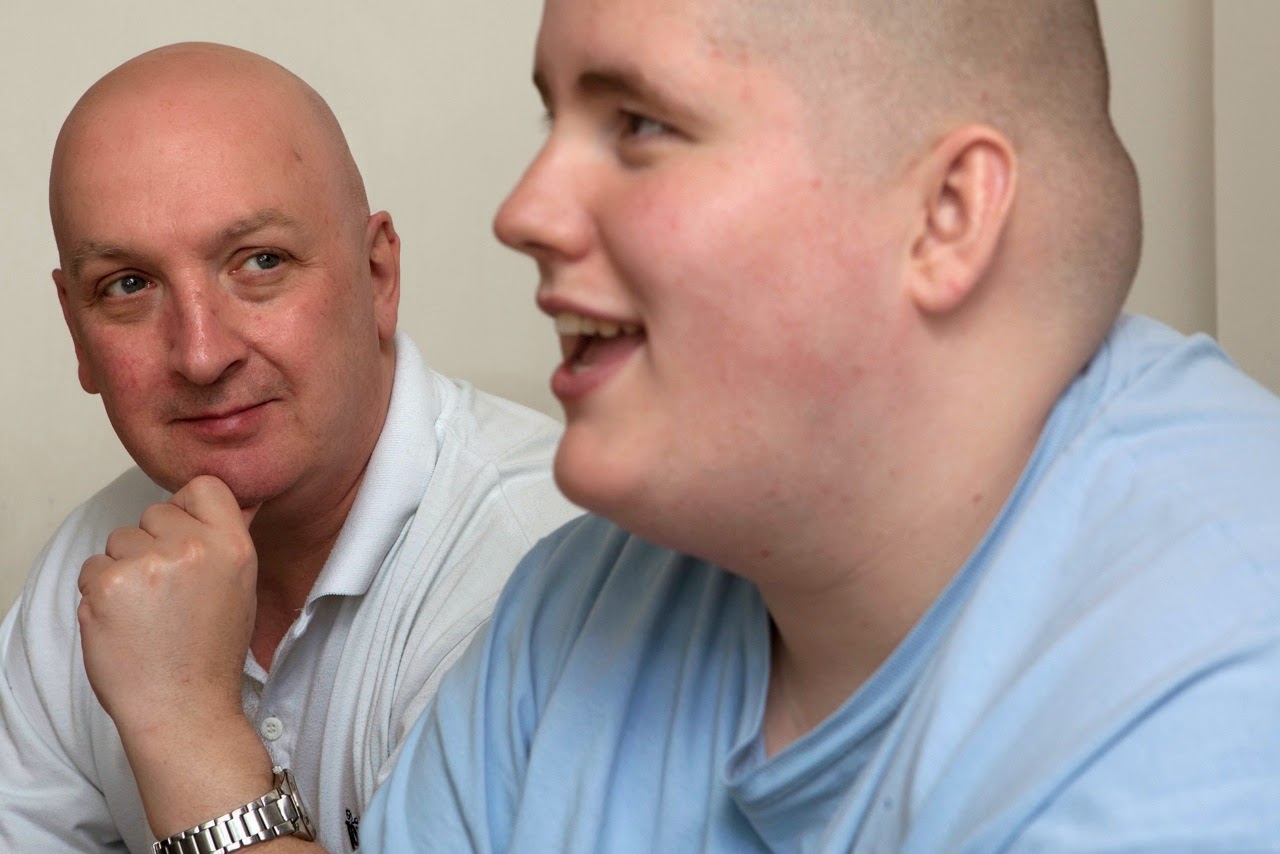
This is the photo that appeared on the front page of The Independent under the title - "The Right To Love"
Thursday, 26 June 2014
Story One Hundred - Verdict
Two weeks later, I was back on the front row of the benches to hear Justice Peter Jackson deliver his judgement. Once again, I found it a very emotional moment. Early on in his judgement he mentioned Magna Carta and a huge tsunami welled up as my 800 year old history tumbled out. It is very trippy to travel 800 years in the space of two minutes.
I'm handing this post over to Justice Jackson as (IMO) he got the judgement spot on. He found that Hillingdon had acted unlawfully and deprived Steven of his Article 5 & 8 Human Rights and that all four DoLs were illegal.
Here are some of the highlights:
I'm handing this post over to Justice Jackson as (IMO) he got the judgement spot on. He found that Hillingdon had acted unlawfully and deprived Steven of his Article 5 & 8 Human Rights and that all four DoLs were illegal.
Here are some of the highlights:
- I want to thank Mr Neary for the quiet way in which he has presented his case. Several times, both during his evidence and when acting as advocate, he had the opportunity to vent grievances or launch an attack on Hillingdon in the presence of the media, but he did not do so. I am sure that this is because his focus has been on Steven from beginning to end. Mr Mark Neary is an unusual man and he can be proud of the way in which he has stood up for his son's interests.
- For the reasons set out later on, I do not accept Hillingdon's arguments. I find that Steven was deprived of liberty throughout the year. I reject its case that Mr Neary consented. The authorisations relied upon were flawed, and even if they had been valid, they would not in themselves have amounted to lawful authority for keeping Steven at the support unit
- It follows that Hillingdon had no lawful basis for keeping Steven away from his home between 5 January 2010 and 23 December 2010. The fact that it believed that it was acting for the best during that year is neither here nor there. It acted as if it had the right to make decisions about Steven, and by a combination of turning a deaf ear and force majeure, it tried to wear down Mr Neary's resistance, stretching its relationship with him almost to breaking point. It relied upon him coming to see things its way, even though, as events have proved, he was right and it was wrong. In the meantime, it failed to activate the statutory safeguards that exist to prevent situations like this arising.
- Fortunately, the evidence establishes that Steven has suffered no significant or long-term harm as a result of these events, although they were distressing for him and for his father. However, things might easily have turned out differently. By the summer of 2010, Hillingdon's plan was to send Steven to a long-term placement somewhere outside London, which could have caused irretrievable damage to his family ties, and particularly his very close relationship with his father. In the case of at least one of the facilities, it was a precondition that Steven was placed under a compulsory Mental Health Act section. It is very troubling to reflect that this approach might actually have succeeded, with a lesser parent than Mr Neary giving up in the face of such official determination. Had that happened, Steven would have faced a life in public care that he did not want and does not need.
- I declare that Hillingdon has breached the rights of Steven Neary in the following respects:
(1) By keeping Steven Neary away from his home between 5 January 2010 and 23 December 2010, Hillingdon unlawfully breached his right to respect for his family life, contrary to Article 8 ECHR.
(2) By keeping Steven Neary at the support unit between 5 January 2010 and 14 April 2010, Hillingdon unlawfully deprived him of his liberty, contrary to Article 5(1) ECHR.
(3) By keeping Steven Neary at the support unit between 15 April 2010 and 23 December 2010, and notwithstanding the urgent DOL authorisation granted by Hillingdon as managing authority and the three standard DOL authorisations granted by Hillingdon as supervisory body, Hillingdon unlawfully deprived him of his liberty, contrary to Article 5 (1) ECHR.
(4) By failing to
(i) refer the matter to the Court of Protection sooner than 28 October 2010, and/or
(ii) appoint an Independent Mental Capacity Advocate for Steven sooner than 29 October 2010, and/or
(iii) conduct an effective review of the DOL best interests assessments under Part 8 of Schedule A1 of the Mental Capacity Act 2005,
Hillingdon deprived Steven Neary of his entitlement to take proceedings for a speedy decision by a court on the lawfulness of his detention, contrary to Article 5 (4) ECHR.
- By this stage, Steven's behaviour was causing grave concern to professionals and to Mr Neary. The latter describes himself as quite overwhelmed by the number of issues arising daily, and feeling very emotional himself. He described in evidence how in the period between January and April he got caught up in lots of micro-events and lost sight of the bigger picture. He accepts that during these weeks he was not actively objecting to Steven being in the support unit, even though he had never agreed to it. By 25 January, a meeting was taking place between Mr Neary and the professionals which focused exclusively on practical day-to-day issues.
- I again accept this description of events. Regrettably, once Mr Neary's initial resistance to its plans weakened and fell away, Hillingdon appears to have taken a dim view of his concerns. In an e-mail dated 22 February from the social worker to the support unit, the following appears: "There is always going to be something or other that Mr Neary will bring up and more often than not we are having to appease his needs rather than Steven's, however I want Steven to remain at [the support unit]. I know that it seems that you as a team are constantly being questioned but this will be the case because Mr Neary wants to find issues with the care that other people give Steven. We just need to ensure like we have that we are working together for the best outcome for Steven."
- It is now accepted by Hillingdon that Mr Neary had done nothing to deserve this disrespect. The unfortunate tone of the message demonstrates that even at this stage the expression "working together" did not include working together with Steven's father in the true sense and that Hillingdon's thinking had by this stage become adversarial. Worse, the professional view was withheld from Mr Neary, perhaps because revealing it would have provoked a renewed challenge. In the meantime, a "transition plan", ostensibly leading towards a return home, was put into place. It started on 4 March, with four phases: (1) 4/6 weeks of return home on Monday afternoons, (2) 4/6 weeks of return home on Monday and Tuesday afternoons, (3) the above plus Saturday afternoons at home, (4) the above plus a couple of overnight stays before a final return home. It was not until 8 July, by which time the four phases had been successfully accomplished, that Hillingdon told Mr Neary that it was not willing to return Steven to his care.
- The mere fact that a local authority's view of best interests is not subsequently upheld by a court does not of course show that Article 8 rights have been infringed. However, in the present case, a number of features collectively persuade me that Steven's right to respect for his family life was breached.
(1) Hillingdon approached matters without any proper regard to the principle set out in the previous paragraph. Nowhere in their very full records of Steven's year in care is there any mention of the supposition that he should be at home, other things being equal, or the disadvantages to him of living away from his family, still less an attempt to weigh those disadvantages against the supposed advantages of care elsewhere. No acknowledgement ever appears of the unique bond between Steven and his father, or of the priceless importance to a dependent person of the personal element in care by a parent rather than a stranger, however committed. No attempt was made at the outset to carry out a genuinely balanced best interests assessment, nor was one attempted subsequently. The first best interests assessment that deserves the name is the IMCA report of 18 November 2010.
(2) Hillingdon's approach was calculated to prevent proper scrutiny of the situation it had created. In the weeks after Steven's admission, it successfully overbore Mr Neary's opposition. It did not seriously listen to his objections and the suggestion that it might withdraw its support for Steven at home was always likely to have a chilling effect. Once Mr Neary's resistance was tamed, the question of whether Steven was in the right place did not come under any balanced assessment.
(3) Between April and July 2010 Hillingdon pursued two inconsistent agendas. The professionals were opposed to Steven returning home, whether or not a final decision had been taken. The agenda so far as Steven and Mr Neary were concerned was a return home under the transition plan. It was only when the transition plan was about to lead to an actual return home that the pursuit of two agendas became unfeasible and the true view of the professionals was disclosed. The records show that the professionals were at times uneasy about this lack of frankness, but it happened nonetheless.
(4) The use of DOL authorisations from April to December 2010 as a means of controlling Steven's activities was not justified on the information available to Hillingdon. As a direct result of an incident when he had not been adequately supervised, he was deprived of activities that are important to him for weeks and in some cases months, and he was prevented from going on holiday.
(5) Even in July 2010, when the cat of Hillingdon's thinking was out of the bag, it took almost 4 months for an application to court to be issued, with Steven remaining at the support unit in the meantime.
(6) Although Hillingdon has accepted and supported Steven's placement at home since the receipt of the experts' reports in February/March of this year, the application it presented in December 2010 and pursued up to the hearing in May 2011 has contained no concessions to Mr Neary's concerns and no acceptance of any shortcomings whatever in relation to past events. Such concessions as were made emerged in cross-examination. Regrets were expressed, but no apology has so far been made to Mr Neary or to Steven.
(7) On 20 May 2011, the eve of the hearing, Hillingdon circulated a three-page media briefing note to most of the national media. The document was designed to counteract adverse publicity that Hillingdon has received, and against which it had not attempted to defend itself. Nonetheless, it is a sorry document, full of contentious and inaccurate information, and creating a particularly unfair and negative picture of Steven and his behaviour. I learned about the document by chance on the last day of the hearing, expressed dismay, and asked for an explanation. I am told that it was authorised by the Director of Social Care, the Head of Corporate Communications and the Borough Solicitor. It is now accepted "in hindsight" that an error of judgment was made in issuing the briefing note. That is indeed so, though again hindsight has nothing do with it. In addition, Hillingdon has unreservedly apologised to the court. That courtesy is appreciated, although an apology for the document is in truth not owed to the court but to Steven and his father.
Wednesday, 25 June 2014
Story Ninety Nine - The Hearing (3)
Day four had two witnesses: Chris, Steven's other main support worker and me.
Chris was great. As someone who had known Steven since he was 15, his evidence I felt carried a lot of weight. Aswene spent a lot of time with him, asking him to describe Steven pre The Unit. Hillingdon's barrister pursued a familiar line about Steven being a threat to everyone. I didn't really have anything to ask Chris as his evidence had been so thorough.
Then it was my turn. It's weird because I have hardly any recall of the three hours I spent in the witness box. In fact, I couldn't recall anything the day after. The first hour was dreadfully draining as Hillingdon's barrister persisted in trying to get me to state that I'd agreed for Steven to be at the Unit long term. This couldn't go anywhere because it wasn't true but he hammered away for over an hour.
Apart from that, I remember the Judge asking me about my relationship with the Unit manager and the social worker. Aswene asked me about my upset the day before when the team manager gave his evidence and that set me off again. And I was asked to talk about my relationship with Steven, the history, the difficulties, the bond. That was nice but emotional because nobody in the whole year that Steven had been away had been the slightest bit interested in any of Steven's relationships, including his relationship with me. So from the witness box in the Royal Courts of Justice I heard myself talking about Mr Bean, Abba, Take That, Basil Fawlty and all the other key reference points of Steven's life.
We broke for lunch halfway through my evidence and I was reminded that I couldn't talk to anyone as I was still under oath. I went at sat in a park by the Embankment and the loneliness of the whole week hit me. I had been told that as the CoP was a private court, I couldn't have anyone with me. But Hillingdon had a whole group of people there the whole week. When I got back, I checked this out with Sophy and I learnt I had been misinformed. Perhaps it was for the best - I was able to concentrate on being a litigant in person without the distraction of having friends there. But it would have been nice to have some support.
The final day was taken up with the closing addresses. Hillingdon's address took the whole morning. It wasn't meant to be that long but the Judge took them apart over the legality of the DoLs. I was making copious notes, trying to get some clue of what the final outcome might be. I counted 24 comments from the Judge that seemed to be in our favour. Aswene was given a much easier ride, which again, seemed to be a point in our favour.
The last afternoon was packed with the drama of the revelation of Hillingdon's vile press release. After it was leaked, Aswene was furious and we went back into court and the judge expressed his "dismay". The Hillingdon press officer was called into the witness box but it was the same pattern as the whole week - it was impossible to work out who made the decisions. Nobody was prepared to take any responsibility.
And with that, it was all over. Reconvene in two week's time for the judgement to be handed down. I had never felt so exhausted in my life. It was going to be a long two weeks until 9th June.
Tuesday, 24 June 2014
Story Ninety Eight - The Hearing (2)
Day three was a packed day with three witnesses.
First cab off the rank was Francis, the support worker who had been with Steven most days during his time in the Unit. He is one cool dude and never got ruffled by the grilling he got from Hillingdon's barrister. My cross examination was brief - just getting Francis to describe Steven before, during and after his time in the Unit. Unlike the previous day when the Unit manager constantly sought reassurance from his managers, I knew that Francis could speak his absolute truth with assurity and integrity.
Second witness was the expert witness. This was the psychologist who Steven had described as Neil Tennant. His evidence repeated what he had written in his report and he was resolute that the best place for Steven was in his own home. He also flagged up one of the problems of functional analysis - challenging behaviour arising from the confinement being used as a reason to continue the confinement. It's clear from the final judgement that the psychologist's evidence carried a lot of weight for the judge, so I am forever grateful that he was such a fair, considered man.
The final witness was the social worker's manager. With the social worker still off sick as a result of the anonymous letter, it fell to him to present the case for the social care team. He got a very hard time from Aswene and it was strangely satisfying to see the amount he was sweating. Aswene went through 10 points of the Mental Capacity Act with him, and he had to admit that they had failed on all 10. At this point, Aswine said: "Is this a good opportunity to offer an apology to Steven and Mr Neary?". And at that point, I broke down. This incredible sob from somewhere very deep emerged and the court usher came rushing forward with a box of tissues. I guess it was the release of a whole year of the most terrible pressure. I managed to compose myself for the cross examination. The manager had told the judge that he regretted the lack of openness in the way they had dealt with me and Steven the first part of the year and in July, they had decided to be more transparent. I knew that I had him so I quickly thumbed through the six binders of written evidence and found and email from September. It was about the psychologist's report from August that the council didn't want me to see and they sat on it until the end of October. The last line of the email was:"Mr Neary has not been shown this report". I got the manager to read this line out and then said to him: "So, although you decided as a team in July to be more transparent with me, that email from 27th September shows quite the opposite. No further questions". And sat down.
That was the Hillingdon case. All of their three witnesses had given their testimony and it had been a shambles. At the end, the judge questioned the manager who admitted that one of the senior managers had a "wobble" about the council's stance and that she had resigned a couple of weeks before the hearing. He also said how in October the new director of social care had also expressed concern but it didn't change the corporate decision.
It was a very dramatic end to the day. On the way home, I phoned Val to give her an update and later she sent me a text that read: "Forget the book. Forget the film. This is an opera".
Subscribe to:
Posts (Atom)